
Virginia Beach Projected Versus Actual Release
A projected release date is a working calculation based on the sentence documents and credit information then available. The actual release date records when custody under that agency ends. Those dates can match, but they answer different questions. VBSO Inmate Services and Records reviews local court orders, offense dates, sentence types, sentence length, and prior time served. VADOC performs the computation for qualifying state-responsible sentences.
A pretrial detainee has not begun serving a final sentence merely because the person is in Virginia Beach Correctional Center. Release may turn on personal recognizance, surety bond, dismissal, or another court order. A magistrate or court order can authorize release, yet another case or detainer may keep the person held. The court owns the legal order. VBSO owns the physical local custody transaction. Both may be needed to establish what happened.
Scheduled versus actual: A computed date is provisional. Only the responsible jail or corrections record confirms the custody event and destination.
For a sentenced person, “release” also may mean a transfer of authority. A person can leave VBCC for a VADOC facility, complete VADOC confinement and begin parole, or move to another lawful custodian. The date by itself does not prove arrival in the community. Read status, agency, and destination with it.
Find a Virginia Beach Release Date
Begin with the last known custodian and sentence type. The VBSO current-inmate lookup can show whether a person is publicly listed in current VBCC custody, but it has no documented historical release tab or release-date field. A missing name is only a clue. For a local sentence, VBSO Records/Inmate Services and the Virginia Beach court file are the main sources. For a state sentence, use VADOC’s time-computation and records channels.
- Identify whether the person is pretrial, serving a city-jail sentence, or under a state-responsible sentence. Do not assume from the building alone.
- Check the current VBSO listing for local custody, then read the court’s bail, commitment, judgment, and sentence orders.
- For state responsibility, search the VADOC Inmate and Supervisee Locator by seven-digit DOC ID or qualifying name fields.
- Use the official VADOC time-computation explanation to identify the credit system tied to the offense date.
- Request the existing time-computation record when the exact calculation matters. Include the person’s identifiers, case, facility or district, and date range.
- Confirm the actual event with the agency holding the person, then check any receiving system if transfer or a detainer is possible.
VADOC’s public locator landing page confirms its search inputs and daily update warning. CAPTCHA prevented a stable audit of the detail result, so no exact field called “Projected Release Date” or “Tentative Release Date” is promised here. The official time-computation page and the person’s existing VADOC record are the sound sources until a live result establishes the field label.
The official VADOC locator shows the search route and its scope.
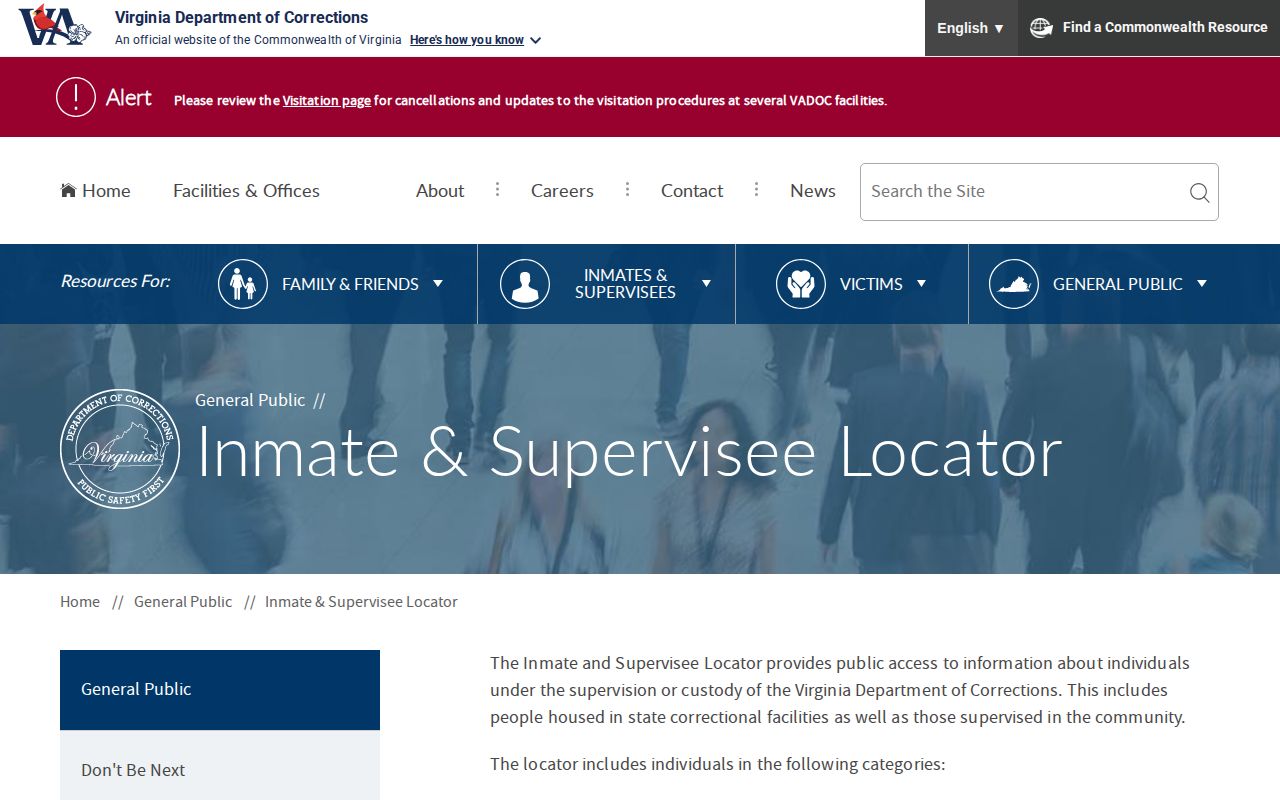
The captured landing view supports the locator process, but it does not justify inventing a result field that was not verified.
Note: Preserve the date checked because both the VBSO listing and VADOC locator are dynamic records that can change.
Virginia Beach Jail and VADOC Dates
Virginia Beach Correctional Center holds several populations. They include people awaiting trial, people serving misdemeanor terms of one year or less, and people waiting for VADOC transfer. A person may also be physically housed in a local jail while already under VADOC authority. The agency responsible for sentence computation cannot be inferred solely from the street address where the person sleeps.
For a local jail sentence, start with the signed court order and all prior-time-served credit. VBSO says its Inmate Services and Records staff then considers sentence type, offense date, active term, and applicable credit. Behavior and rule violations may affect earned time. The authoritative answer belongs to VBSO or VADOC, not to a hand calculation based on a docket summary.
For an active or combined state-responsible sentence longer than twelve months, VADOC computes the dates described in its rules. The system can include parole eligibility, mandatory parole release, good-time release, or earned-credit release depending on the governing law. A court order can later amend the sentence, and VADOC may receive jail-credit material after an early estimate was made.
The VADOC locator is updated daily and also covers active community supervision. A result outside an institution may therefore reflect parole or probation after confinement, not a projected day still waiting to occur. Fully discharged historical coverage is not promised. When the person no longer appears, an inactive-record request is safer than treating a blank search as proof of the final date.
Questions about an exact state calculation may be sent to VADOC’s Correspondence Unit or Court and Legal Section at PO Box 26963 or 6900 Atmore Drive, Richmond, VA 23261. A focused records request should ask for the existing sentence and time-computation record, not a new legal opinion. VADOC may apply exemptions and fees under Virginia FOIA.
Virginia Beach Release Credit Systems
Virginia uses more than one credit framework. Good Conduct Allowance, or GCA, generally applies to felony offenses committed before January 1, 1995 and misdemeanors committed before July 1, 2008. For active or combined parole-eligible GCA sentences longer than twelve months, VADOC calculates relevant parole and good-time dates. Its public explanation describes zero to thirty good-conduct days for each thirty days served, based on classification.
Earned Sentence Credits, or ESC, generally govern felony offenses committed on or after January 1, 1995. These sentences usually are not eligible for discretionary or mandatory parole, subject to statutory exceptions. Virginia Code §53.1-202.3 sets the rates. Enumerated ESC-1 offenses can earn from zero through 4.5 days per thirty days served, depending on class. Eligible ESC-2 offenses can earn up to fifteen days per thirty days served. Sections 53.1-202.2 and 53.1-202.4 address eligibility and administration.
- Active term
- The part of a sentence ordered to be served in confinement.
- Jail credit
- Time already spent in qualifying custody that is credited against the sentence.
- GCA
- The older Good Conduct Allowance system tied to offense type, date, and classification.
- ESC
- The Earned Sentence Credit system governing many later felony sentences.
- Detainer
- A request or legal basis for another authority to assume or continue custody.
A blanket claim that every Virginia prisoner serves 85 percent is inaccurate. The often-cited maximum of 4.5 credit days per thirty served works out to about 86.96 percent of the adjusted total, and some eligible offenses may earn at the higher ESC-2 rate. The statute, offense group, earning class, and current record must control.
The VADOC time-computation page sets out how the agency separates GCA and ESC cases.
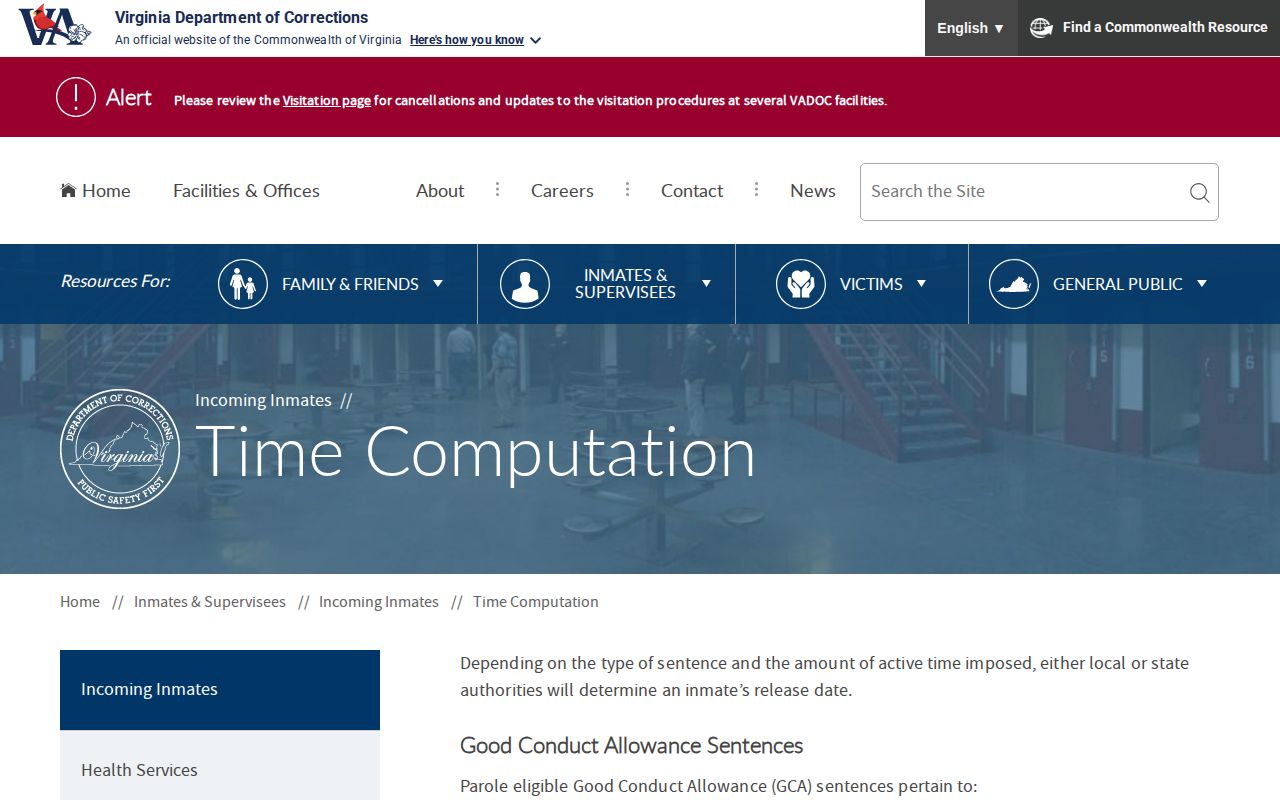
The source view is the proper starting point for choosing the applicable framework before reviewing a person’s own computation record.
Note: Credit rates describe what may be earned under the applicable law; they do not establish one person’s final release date.
Why Virginia Beach Release Dates Change
An early estimate can move for both legal and administrative reasons. VADOC may still be waiting for a complete sentencing order or local jail-credit record. Conduct can change the earning class or lead to lost credit. A later court order can correct or amend the conviction or sentence. New custody information may also establish another term or detainer that was not part of the first calculation.
| Factor | Effect on the projected date | Best confirming source |
|---|---|---|
| Corrected jail credit | Adds or removes qualifying prior time | Court order, jail record, VADOC computation |
| Consecutive or concurrent terms | Changes how multiple sentences combine | Sentencing orders and agency computation |
| Earning-class change | Changes the rate of future credit | VADOC or VBSO time record |
| Disciplinary action | May reduce or remove earned credit | Responsible correctional agency record |
| Amended conviction or sentence | Can alter the active term and legal basis | Virginia Beach court order |
| Detainer or another sentence | May prevent community release on the first date | Holding and receiving agencies |
| Parole action | Can affect an eligible parole-law case | Virginia Parole Board and VADOC |
Destination remains a separate question. A date can mark the end of one custody term yet be followed by parole, probation, another jail, federal custody, or immigration custody. For that reason, the sound check matches the calculated date with the actual status and receiving agency.
Virginia Beach Weekender Release Dates
Virginia Beach has a distinctive modified-incarceration path. VBSO describes a weekender program in which court-ordered confinement is served in nonconsecutive periods. Participants report to the Sally Port on the dates set by the court. A person can be outside the jail between reporting periods while still serving the custodial sentence. That physical absence is not final release and is not full discharge.
The VBSO modified-incarceration page lists a one-time $50 processing fee and a $7 daily charge for the program. Those are program charges, not fees to view a release record. It also provides a program contact number of 757-385-1050. The court order and VBSO schedule control the required reporting periods.
A current-roster search is especially weak proof in a weekender case. The person’s absence may be part of the ordered schedule. Ask whether the sentence was fully completed, whether another report period remains, and what date the agency records as final release. The distinction prevents a temporary period outside VBCC from being reported as sentence completion.
Confirm a Virginia Beach Release Date
The final check should join the computation, custody event, and destination. For VBCC, call 757-385-4555 for a prompt current-status inquiry and request the release transaction when a durable date and reason are needed. For a VADOC sentence, ask for the time-computation and actual-release or discharge record. A court record explains the legal authority but may not show the minute staff completed the departure.
Local Jail VINE can send a custody-change alert for a person held in a Virginia local or regional jail. Its official workflow warns that “released/transferred” can accompany movement into VADOC, so the receiving system must be checked. State-prison notifications now use NAAVI for eligible registrants. Registration does not carry from the local system into NAAVI.
The Virginia Beach VINELink release check explains how to register and interpret a local jail event. A notification is useful for timing, but it is not a certified time-computation record. Preserve the alert, then confirm it with VBSO, VADOC, or the court based on the fact at issue.
Important: “Not listed,” “released,” and “discharged” are not interchangeable. Confirm the agency, date, and destination before drawing a conclusion.