
Virginia Beach Parole Versus Probation
Parole and probation both allow a person to live in the community under set terms, but they begin in different ways. The Virginia Parole Board decides parole in cases that remain eligible. VADOC probation and parole officers then manage community supervision. Probation is imposed by a court. It may follow active jail time, a suspended sentence, or a local disposition with no prior state-prison release. A person on either form of supervision is outside an institution but has not necessarily reached sentence discharge.
Virginia largely ended discretionary parole for felony offenses committed on or after January 1, 1995, subject to exceptions. Eligibility depends on the offense date, sentence history, offense class, and statutory cohort. The controlling rules are in Virginia Code §53.1-151 and §53.1-165.1. Age or sentence length alone cannot settle eligibility. Older parole-law sentences also use commitment-based formulas and exclusions that require review of the live statute.
| Point | Parole | Probation |
|---|---|---|
| How it begins | Board-authorized release for an eligible sentence | Court-ordered community supervision |
| Prior prison term | Usually tied to a prison sentence | Not always required |
| Local supervisor | VADOC District 23 when assigned in Virginia Beach | VADOC District 23 for state supervision; some local cases use city Community Corrections |
| What a result proves | Active community supervision, not full discharge | Active court or correctional supervision, not custody in a jail |
- Parole
- Conditional community release before an eligible prison sentence fully ends.
- Probation
- Court-ordered supervision in the community, often tied to a suspended sentence.
- Discharge
- The formal end of correctional supervision, which is distinct from leaving confinement.
- Absconder
- A supervised person whose location remains unknown after reasonable efforts to find them.
Check Virginia Beach Post-Release Supervision
The official starting point is the VADOC Inmate and Supervisee Locator. Its scope includes people in institutions, people supervised by probation and parole districts, some VADOC-responsible people held in local or regional jails, and Community Corrections Alternative Program placements. The data updates daily. A community-supervision result is meaningful, but a missing result is not proof of discharge. It can reflect a spelling issue, update lag, a fully inactive record, or another form of local supervision.
Use a specific, matched identity. The search accepts a seven-digit DOC ID, or at least the first three letters of a first name with the full last name. Location, race, gender, and age range can narrow similar names. The locator uses a disclaimer and CAPTCHA. Its role is different from the VBSO current-inmate lookup, which lists present Virginia Beach Correctional Center custody rather than people who have moved into the community.
- Search by the seven-digit DOC ID when known. Otherwise, use the required name fields.
- Apply optional details to separate people with similar names, then read custody and supervision information together.
- Look for a Virginia Beach district assignment or community status. Do not treat that status as full discharge.
- Contact District 23 when the result points to local state supervision and a routing detail needs confirmation.
- For a person absent after full discharge, request existing inactive supervision records through VADOC FOIA and identify Form 17 where relevant.
- Check the court disposition when probation came from a local case and no VADOC result appears.
A short stay at Virginia Beach Correctional Center does not ensure that VADOC will hold a record. Local Community Corrections handles some post-disposition cases, while Pretrial Services handles people before adjudication. Those are distinct from state parole. For the complete local release event and its legal basis, use the Virginia Beach released-inmate search and records path.
Note: A Virginia Beach community-supervision result confirms status on the check date, not the final end date of every obligation.
Virginia Beach Supervision at District 23
VADOC District 23 is the named state community-supervision office for the City of Virginia Beach. It is not a jail. A person reported there may be on parole, probation, or another VADOC community status. The office is the logical local route after a matched locator result identifies Virginia Beach supervision, yet it should not be used to infer that a person was released from the city jail on a certain date.
VADOC District 23 Probation and Parole
2520 Nimmo Parkway
Virginia Beach, VA
Phone: 757-821-7575
Service area: City of Virginia Beach
The official VADOC directory displayed ZIP 23546 at the research date. Verify the mailing ZIP before sending documents.
The directory also named Rachel Gholston as chief on the research date. Staff assignments can change, so the office number and current directory are better routing tools than a stored name. District staff may confirm where to direct a procedural question, but access to case details can be restricted. A public locator result and an existing record request remain the durable paths.
The official District 23 listing can be reviewed in the VADOC facilities and offices directory.
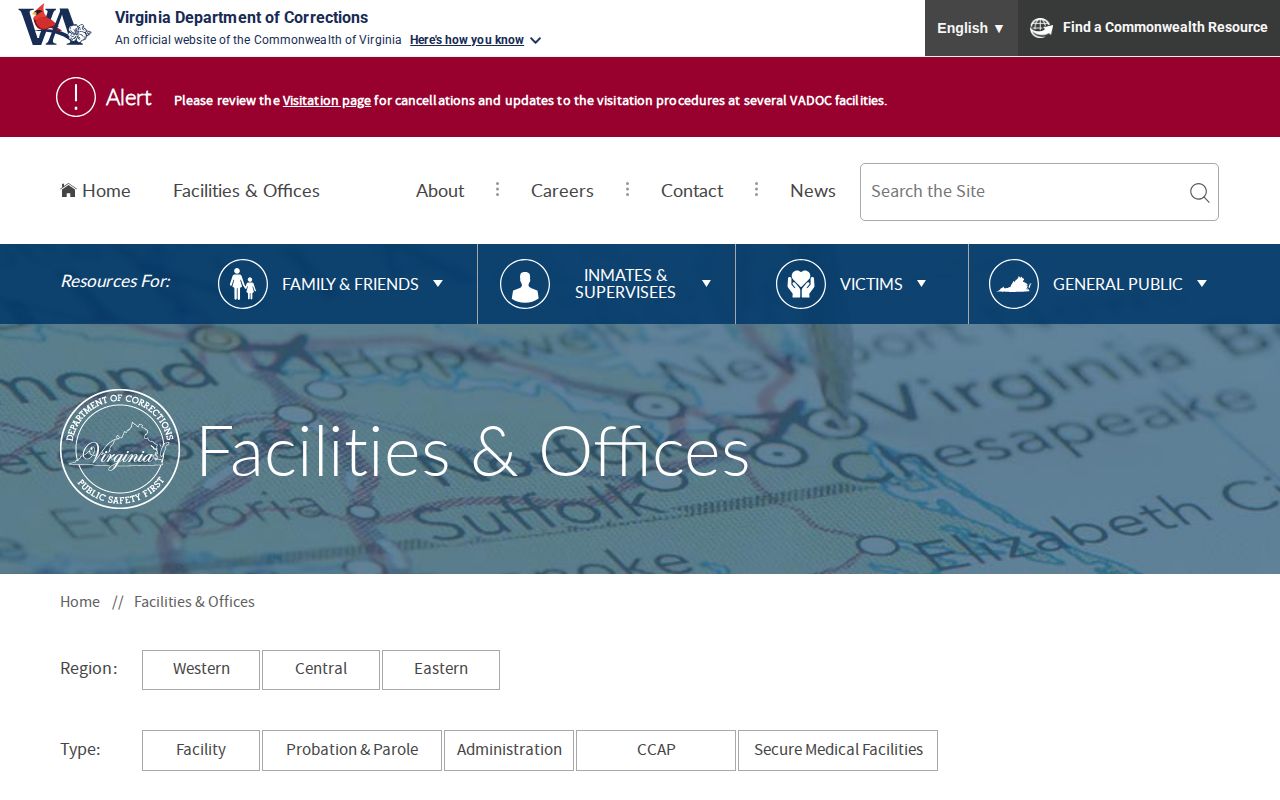
The captured directory view ties Virginia Beach supervision to District 23, while also showing why mailing details should be checked at the source.
Virginia Beach Parole Board Records
The Virginia Parole Board’s public material serves a different purpose from the VADOC locator. The public meetings page lists posted meeting dates, agendas, live access details, and prior minutes. Meetings are event-driven and irregular. The calendar must not be presented as a fixed weekly or monthly hearing schedule, and a person’s eligibility does not guarantee that an individual public meeting will appear there.
Final deliberation and voting in qualifying cases have required a public meeting since July 1, 2024, but the scope is not universal. For process questions, the Board’s Victim Input Unit is available at 804-887-8184. The Board says it does not give pending case status by phone. A parole grant starts planning and conditions. It does not prove that physical release from a facility happened that day.
Published outcomes can include granted, not granted or denied, and deferred. Monthly decision files, annual discharge data, and consideration statistics are posted in the Virginia Parole Board report archive. That archive covered 2021 through 2026 at the research date. It is a set of reports, not a live name-search database.
The monthly reports provide a dated Board-action trail, while VADOC and the holding facility own later custody and supervision facts.
Note: A parole grant authorizes the next phase of the case; it is not the same event as release or discharge.
Virginia Beach Supervision Violations
Conditions are the rules attached to parole or probation. They can include reporting, approved travel, treatment, testing, payment, or compliance with court directions, but the exact order and supervision documents control. A violation allegation does not itself prove a new conviction or final revocation. The supervising officer, court, Board, or other authorized decision-maker must address the case through the process that applies.
No complete statewide public name list of Virginia probation and parole absconders was verified. VADOC Operating Procedure 920.6 defines an absconder as a probationer or parolee whose whereabouts remain unknown after reasonable efforts. An officer may obtain a PB-15 arrest warrant and enter it for law-enforcement use. A press release or “Most Wanted” item is not a complete supervision index, so absence from such a list proves nothing.
Important: Treat an absconder label or warrant reference as an alleged supervision and custody issue. Confirm current status with the responsible official source.
Jail VINE can provide notice of a later local custody event if the person is booked into a participating jail. It is not a parole-violation database. VADOC records, District 23, court records, and the Board’s published actions each answer narrower questions. Matching the agency to the fact prevents a warrant, custody booking, and supervision discharge from being blurred together.
Virginia Beach Reentry Before Supervision
The Virginia Beach Sheriff’s Office describes a three-month Reentry Program as part of its jail reintegration work. VBSO also identifies Recovery and Veterans programming. These local programs may shape preparation for a person leaving Virginia Beach Correctional Center, but enrollment does not prove that release happened. A program record and a release transaction document different events.
After a state-supervised person enters the community, District 23 becomes the separate VADOC contact. Local Community Corrections can also serve people under a city court order. The distinction matters. Someone can complete a VBSO program, leave the jail, and have no state parole at all. Another person may transfer into VADOC rather than return to the community. A third may report to District 23 on an active supervision term.
The VBSO reintegration program description identifies the local preparation work and modified-incarceration options. Confirm the actual release through VBSO, VADOC, and the court route that applies to the person.
Note: Program participation describes preparation or placement; only a custody record confirms whether Virginia Beach confinement actually ended.
Virginia Beach Release Property and ID
Post-release supervision often starts with basic records and personal items. The May 2026 VBSO rulebook says personal property is returned on release and the person signs an acknowledgment. Transfer works differently. Only allowed property travels with the person, while other items are mailed to a supplied address that is not a post-office box. Without such an address, the rulebook says the property may be treated as abandoned and disposed of after two weeks.
The same rulebook describes a DMV ID Card Program for qualifying inmates before release. It should not be read as a promise that every person receives identification. Eligibility and completion still matter. For someone reporting to parole or probation, the release paperwork, identification, and supervision instructions should be kept separate but available. A property voucher proves what happened to stored items, not whether a sentence was discharged.
Questions about property released from Virginia Beach Correctional Center belong with VBSO. Supervision-reporting questions belong with District 23 or the court-directed local office. That division tracks the agencies’ actual roles and avoids asking a parole office to reconstruct a jail property transaction.
Virginia Beach Supervision Discharge Records
Discharge is the formal end of supervision. It is not the day a person first leaves confinement, and it is not established merely because a name is absent from a locator. A person can be released from prison to parole, leave jail for probation, or live in the community while still under VADOC authority. The end record may be held by VADOC, the court, or both, depending on how supervision began.
For an inactive state record, ask VADOC for existing custody and status history, supervision start and end dates, actual release or discharge date, and the manner of release where those fields exist and are releasable. Form 17 is titled “Request for Inactive Inmate or CCAP Probationer/Parolee Records.” Virginia FOIA gives access to existing public records subject to exemptions. It does not require an agency to create a new explanation.
A court order is the better source when probation began in a Virginia Beach case. The order can establish the sentence, suspended term, conditions, or later modification. VADOC owns its state case-management facts, while the court owns its orders. Together, those records distinguish release, active supervision, and final discharge.